The process
Compliant bird management for construction, facilities and environmental projects
Construction firms, facilities managers and environmental consultancies need bird management that is documentable, non-lethal, and WCA 1981 compliant — and that fits around live site operations without introducing additional risk. That is what we provide.
The process is straightforward: a free site assessment, a clear written proposal, and a programme that can be built into your project schedule, environmental management plan, or facilities contract from day one.
No physical installation. No structural fixings. Nothing that affects listed building or planning status. If project scope changes, the programme scales or pauses with it. Where you have an established environmental or ecology team in place, we work alongside them — not around them.
The process
-
Initial enquiry
Tell us about your site and the requirement
Call or email with your site location, the bird species involved, and the nature of the problem — whether that's an active nesting risk during demolition, a hygiene or compliance issue at a live facility, or an environmental mitigation requirement written into a planning condition. We'll confirm quickly whether falconry is appropriate and what a programme would look like at your scale.
By phone, email, or the contact form — whichever suits your procurement process -
Free site survey
Free site assessment — on your terms
We carry out a free site visit covering bird activity zones, access and logistics, health and safety requirements, and any environmental or planning constraints relevant to the site. For construction environments, we'll work within your existing site induction and permit-to-work procedures. We'll identify species, assess nesting risk during active phases, and confirm what a compliant, non-lethal management programme looks like for your project.
No charge. No obligation. RAMS and site induction requirements accommodated. -
Written proposal
Written proposal — documentable and clearly scoped
Our written proposal sets out species, deployment schedule, method, access requirements, and fixed cost. It is structured to support inclusion in an environmental management plan, facilities contract, or planning ecology submission. We can provide documentation confirming WCA 1981 compliance and non-lethal method for regulatory or client-facing purposes.
Fixed price. Documentation available for EMP, ecology reports, and compliance records. -
Programme start
First deployments establish genuine predator presence
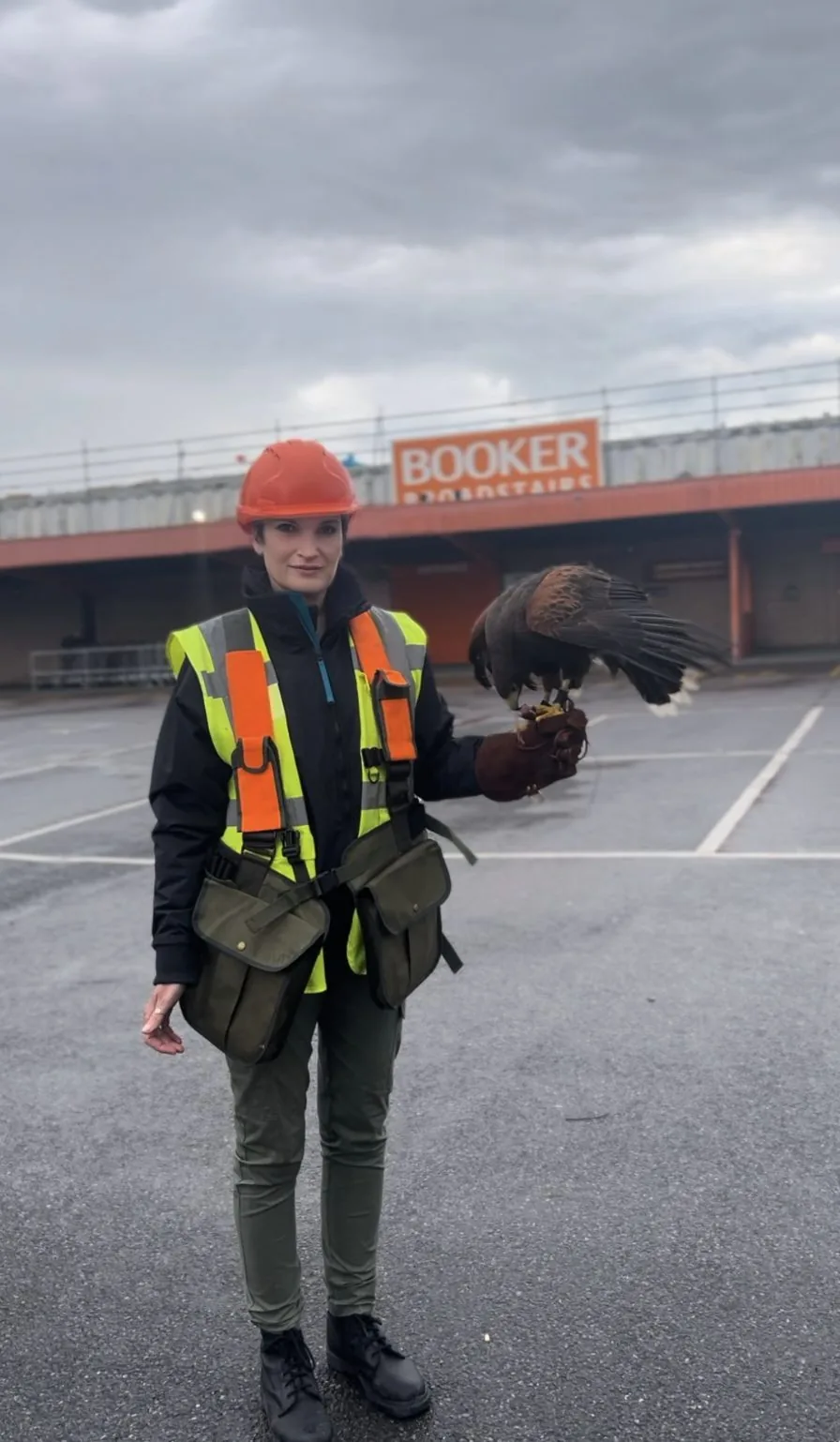
Once the programme is agreed, we begin scheduled deployments using the right bird for the environment. Harris hawks are highly effective across urban, commercial and industrial sites. Peregrine falcons and gyr falcons are deployed where the bird pressure, site scale or target species requires them. The early sessions are the most intensive — establishing recognised predator presence and displacing established populations. Unlike static or audio deterrents, birds are generally less likely to habituate to a live predator presence; the instinctive response to an active raptor is harder to override than adaptation to a fixed object or a repeated sound.
Harris hawks, peregrines and gyr falcons deployed according to site and species requirements. -
Ongoing management
Regular sessions keep pressure low
Bird pressure is not a one-time problem. Populations rebuild, new birds arrive, and seasonal behaviour changes — particularly around nesting season in spring and autumn dispersal. Ongoing scheduled deployments maintain the reduction achieved in the early programme. Frequency is reviewed as the site stabilises and adjusted accordingly. You'll hear from us if anything significant changes.
Programmes can be paused, scaled up or down, or ended with reasonable notice.
No charge. No obligation. We'll confirm whether your site and requirement is a fit.
Who this works for
Specified by construction firms, facilities managers and environmental consultancies
Falconry-based bird management is a recognised non-lethal method suitable for environments where physical installation is restricted, where planning or listed building consent rules out spike strips and netting, or where a documentable, ecology-compliant approach is required by contract or planning condition.
We work with principal contractors, facilities management companies, ecological consultancies, property managers and events coordinators. Where an environmental or ecology team is already established on a project, we integrate with their approach and documentation rather than duplicating it. If your project or site has a bird management requirement, the free site survey is the place to start.
Commercial & retail
Retail parks, distribution warehouses, food production, car parks, shopping centres
Heritage & listed
Grade I and II listed buildings, churches, museums, civic buildings, conservation areas
Construction & demolition
Active demolition, enabling works, new-build phases — nesting bird risk during site clearance, ecology conditions
Industrial & utilities
Energy facilities, manufacturing, process plants, water treatment, landfill
Environmental & ecology
Ecological consultancies, planning ecology conditions, environmental management plans — we can work alongside your established environmental team
Filming & events
Broadcast locations, live events, outdoor venues, sporting fixtures
Common questions
Pigeons and gulls are generally less likely to habituate to a live raptor than to spikes, netting or audio deterrents. A Harris hawk in the environment represents a genuine predator — the instinctive response is avoidance rather than adaptation, and that response is harder to override than familiarity with a fixed object or a repeated sound. Over successive sessions, learned avoidance builds. Birds associate the site with predator activity and reduce their use of it progressively. The key is maintaining pressure consistently, which is why ongoing scheduled deployments are more effective than occasional one-off visits.
Because falconry requires no physical installation on the building — nothing is fixed to the structure — it avoids the listed building consent process that applies to spike strips, netting and other fixed deterrent products. This is one of the principal reasons it is used at Grade I listed buildings, scheduled monuments and within UNESCO World Heritage buffer zones, where physical fixings would require consent and introduce visible change to protected fabric. Individual sites may carry their own permissions or constraints, particularly on ecologically sensitive land or within designations that restrict operational activity. We'll confirm what applies at your site during the survey.
Falconry deterrence is a non-lethal method. The hawk's role is to establish predator presence and cause birds to leave the site — not to catch or kill them. Pest birds are displaced, not harmed. All operations are carried out in compliance with the Wildlife & Countryside Act 1981. We do not deploy methods that injure or kill pest species as part of a deterrence programme.
Once the site survey is complete and a programme agreed, we can typically begin deployments within a short lead time. If your situation is urgent — an active nesting risk during a construction phase, or a time-sensitive event or filming schedule — contact us directly and we'll confirm what's possible.
Spikes and netting prevent birds from landing at specific treated points, but they don't address the wider site. Birds redistribute around them. Falconry operates differently — it works at the site level, not the surface level, and it draws on a biological response rather than a physical barrier. Many of the sites we work on have existing physical deterrent products in place; falconry is used to manage the broader bird population pressure that those products alone can't resolve.
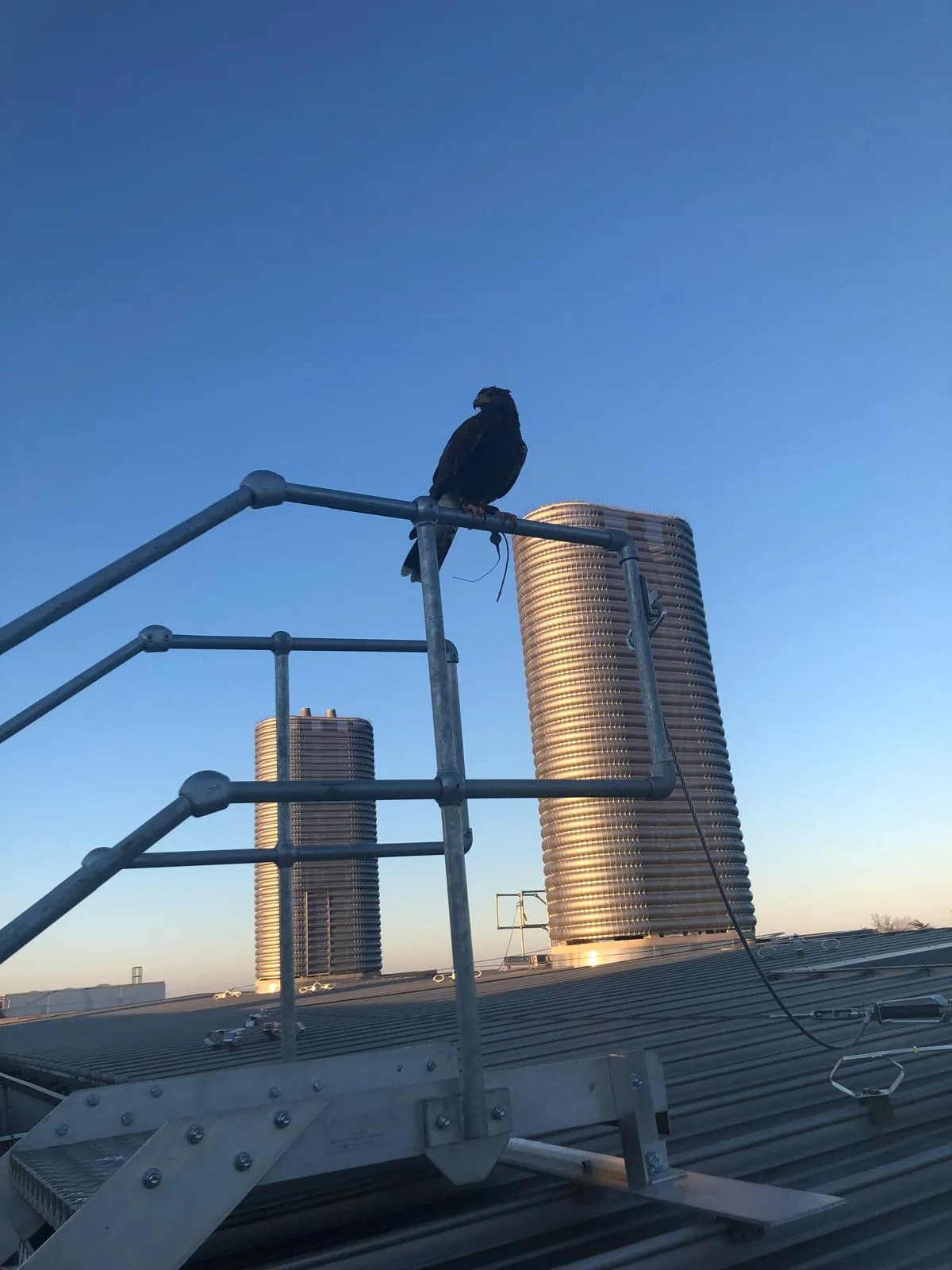
We deploy Harris hawks, peregrine falcons and gyr falcons depending on the site environment and the species causing the problem. Harris hawks are well-suited to complex urban and commercial environments. Peregrine falcons are effective across open industrial, coastal and large-scale sites where aerial pursuit and high-speed presence is the stronger deterrent. Gyr falcons bring size and authority where large gulls or corvids require a more dominant predator response. The site assessment determines the most appropriate bird for each programme.
We operate across the UK. Our base is in North Wales, but we work regularly across England and Wales, including Central London and the South East. If you're unsure whether your location falls within our operational area, call or email and we'll confirm directly.
About the work
A specialist operation — not a generalist pest contractor
Avian Environmental UK is a dedicated falconry-led bird management specialist. We are not a multi-discipline pest control company offering falconry as a line item. That distinction matters for procurement: the knowledge, equipment, and operational approach is specific to this method, and the compliance and documentation we provide reflects that specialism.
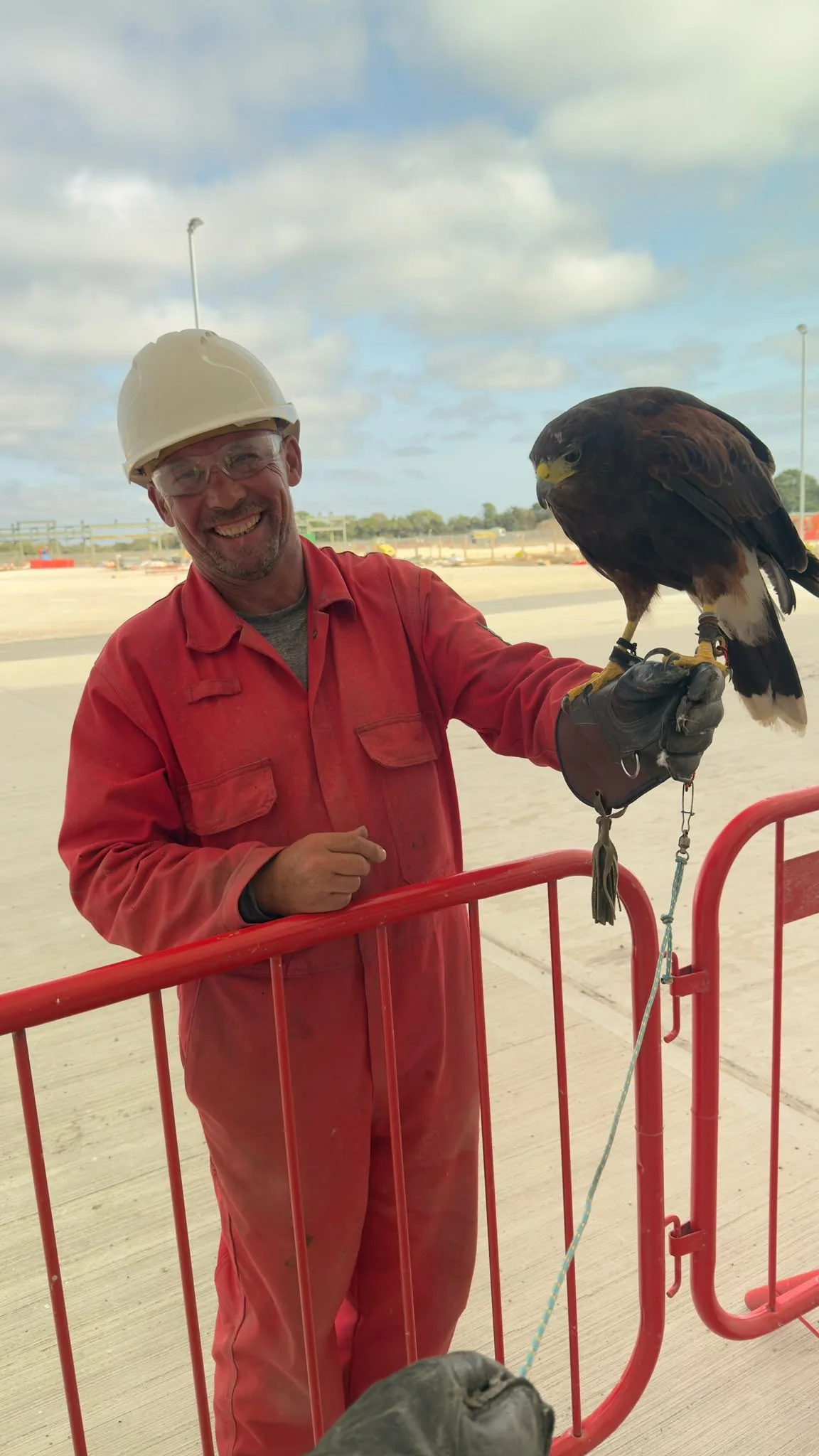
Our track record includes long-term programmes at Westminster Abbey, Wimbledon, industrial construction phases, and a former military airfield bird management contract. Harris hawks, peregrine falcons and gyr falcons are deployed according to environment and target species. All work is WCA 1981 compliant, non-lethal, and fully documented.