Service — Industrial
Commercial gull control for construction, industrial and infrastructure sites
Gulls nesting on an active construction site are not simply a nuisance. Under the Wildlife and Countryside Act 1981, nests and eggs of all gull species are legally protected during the breeding season. An established colony in a demolition or roofing area can halt programme-critical works from April through to late August — at significant cost.
Avian Environmental UK delivers sustained falconry-led gull control programmes for commercial, industrial and construction environments. We work directly within live operational sites: alongside major contractors, on active demolition programmes, across industrial estates and in complex infrastructure settings.
Our approach is not a single visit. It is a managed, adaptive programme that responds to changing site conditions, seasonal bird behaviour and the specific pressures of each environment.
Sector applications
Where commercial gull control is required
Construction & demolition
Active construction, demolition and site preparation
Gulls will establish nesting colonies on partially-completed rooflines, flat-roofed structures, rubble fields and cleared demolition areas. Once nesting begins — typically April onwards — those areas carry legal protection. A programme deployed before the season opens is substantially cheaper than managing an established colony during critical-path works.
Industrial & infrastructure
Industrial estates, warehouses and operational infrastructure
Large flat-roofed industrial and logistics buildings attract gull colonies that contaminate goods, block drainage systems, create health-and-safety risks for staff and generate compliance issues for food-safe operations. Sustained falconry programmes are among the few methods that maintain effectiveness at scale across open industrial environments.
Energy & remediation
Energy sites, former industrial land and remediation programmes
Former gas terminals, power station sites, port infrastructure and remediation projects present complex gull management challenges: large footprints, established breeding populations and ongoing works that create new nesting opportunities as the site evolves. We have operational experience managing gull pressure on exactly these environments.
Operational methods
How commercial gull control works in practice
A managed programme typically combines several methods, adapted according to gull species, site type, breeding stage and operational activity. No single deterrent is sufficient in isolation; sustained presence is what achieves lasting displacement.
Harris hawk and peregrine falcon deployment
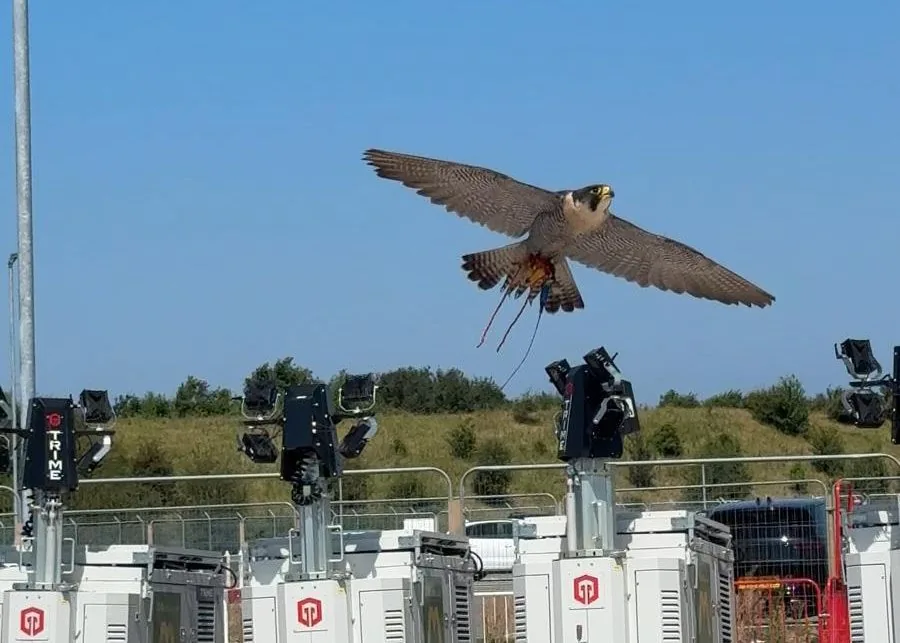
Trained birds of prey create a genuine predator presence that gulls respond to instinctively. Unlike physical deterrents or audio devices, pest birds cannot habituate to a live predator. Harris hawks are particularly effective in confined and urban-industrial environments. Peregrine falcons are deployed for high-pressure management on open coastal and industrial sites where gulls are conditioned to human activity.
Targeted acoustic deterrence
Species-specific distress calls and predator vocalisations, deployed as a complement to active falconry. Most effective when used within a broader programme rather than as a standalone measure — conditioning birds to audio alone accelerates habituation.
Laser deterrence
Effective for roosting dispersal at dawn and dusk, particularly in large open areas where physical access is constrained. Used alongside falconry to maintain consistent pressure across the full operational day.
Continuous observation and field recording
A commercial gull-control programme is only as effective as its observation. We maintain continuous records of bird activity, nesting behaviour, species composition and response to deterrence. This monitoring drives programme adaptation week to week and provides the documentation record required for contractor and environmental reporting.
Foot and vehicle patrols
On large or complex sites, consistent patrol patterns maintain deterrent pressure across the full operational footprint. Patrol routes are adapted as site conditions change — particularly important on demolition and construction programmes where the physical environment shifts week to week.
Case study
Point of Ayr — Liverpool Bay CCS
Operational programme — June to August 2026
During the transformation of the former Point of Ayr Gas Terminal for the Liverpool Bay Carbon Capture and Storage project, Avian Environmental UK delivered a sustained three-month bird-management programme through a complex period of demolition and site preparation in North Wales.
The site presented a demanding interface between an active industrial demolition programme and significant ecological pressure. Ground nesting within parts of the demolition footprint occurred at approximately one metre intervals, placing legally-protected birds within the direct path of construction works.
monitoring, June 2026
operational programme
operational areas at programme end
By August, the principal monitored operational areas — which had recorded dense breeding activity at the programme's start — were consistently clear of active nesting, with low and manageable residual activity. The programme ran continuously through the breeding season, adapting deployment daily as site conditions evolved.
Legal context
Wildlife legislation and gull control
Wildlife and Countryside Act 1981
All gull species nesting in the UK — including herring gull, lesser black-backed gull and greater black-backed gull — are protected under Schedule 1 and Section 1 of the Wildlife and Countryside Act 1981. It is a criminal offence to intentionally take, damage or destroy the nest of any wild bird while it is in use or being built, or to take or destroy an egg.
For commercial sites, this has direct operational implications. A gull colony that establishes on a roofline, demolition area or flat roof during the breeding season (broadly April to late August) cannot simply be cleared. Any works that would disturb an active nest require careful management and, in some circumstances, licensing consideration.
The most effective and legally defensible approach is a pre-season deterrence programme that prevents establishment before nesting begins. Where birds are already present, sustained deterrence during the breeding season can progressively reduce and displace activity — but requires experienced management that works within the legal framework.
Avian Environmental UK operates exclusively through non-lethal methods, in full compliance with the WCA 1981 and relevant licensing requirements.
Discuss a gull-control programme for your site
We provide site assessments and programme recommendations for construction, industrial and infrastructure environments. If you are managing bird pressure on a live site — or want to prevent establishment ahead of the breeding season — contact us to discuss requirements.
We work directly with site managers, project managers, principal contractors and facilities teams.
Send an enquiry
Common questions
Commercial gull control — frequently asked questions
Can we remove gull nests from a construction site?
Once a nest is in use or being built, it is protected under the Wildlife and Countryside Act 1981. Removing or damaging an active nest without appropriate licensing is a criminal offence. The most effective approach is a pre-season deterrence programme that prevents establishment before nesting begins. Where nesting has already occurred, a managed deterrence programme can progressively reduce and displace activity over the course of the season without disturbing protected nests.
When is the gull breeding season and how does it affect construction programmes?
Gulls typically begin nesting from April, with active nesting and chick-rearing continuing through to late July or August depending on species and location. Construction or roofing works that would disturb active nests during this period may require careful management or project programming. A deterrence programme deployed from late February or March — before the first birds begin prospecting for nest sites — can substantially reduce or prevent establishment in sensitive areas.
How long does a commercial gull-control programme typically run?
Programme duration varies by site type, gull pressure and operational requirement. A construction site engagement typically covers the active breeding season — three to four months — with deployment intensity adapted to site programme. Industrial and operational sites may require year-round or annually renewed programmes where gulls have an established relationship with the site. We scope each programme based on the specific environment and advise on the most appropriate approach after a site assessment.
Is falconry-based gull control effective on large open industrial sites?
Yes — on open industrial sites where gulls are conditioned to human presence and conventional noise-based deterrents have limited sustained effect, a live predator programme maintains effectiveness because pest birds cannot habituate to a genuine predatory threat. Peregrine falcons are particularly effective in open coastal and industrial environments where high-flying gull species require an aerial predator response. The programme is most effective when combined with consistent patrol patterns and complementary deterrence methods.
Do you work alongside principal contractors and site managers?
Yes. We are experienced in working within live contractor-managed sites — adapting deployment to site access restrictions, health and safety requirements, programme changes and evolving site conditions. We provide documentation and field reports that support contractor and environmental compliance records. Coordination with site managers and principal contractors is part of how we operate, not an add-on.
Do you cover sites across the UK?
Yes. We deploy across England, Wales and Scotland. We have operational experience across coastal, estuarial and inland industrial environments. For multi-site or extended-duration programmes, we can advise on practical deployment logistics as part of the initial assessment.
Related services
Commercial gull control is part of a broader range of specialist bird-management services for industrial, construction and operational environments.